Bad practices
"Is it reasonable to turn our naturally majestic trees into coat racks?"
These mutilating interventions have major consequences for the health and survival of trees, but also for the landscape, which becomes distorted. These questionable practices must disappear from our cities, thereby reducing the risk that inexperienced and ill-informed residents will reproduce these bad practices in turn.
This section is dedicated to poor pruning practices such as topping, excessive pruning, and "lion-tailing" (or ball-cutting), which reduce the ability to perform photosynthesis and lead to the tree's death in the long term. We will also address disproportionate woundwood/callus tissue, which is another widespread bad practice in the field of arboriculture. We will conclude this section with our perspective on all these practices.
The considerable reduction in leaf surface area decreases the trees' photosynthetic capacity, leading to a major drop in the production of glucose necessary for their maintenance and growth. As the tree weakens, it reacts to this energy drop by stimulating the growth of a multitude of sprouts and suckers that block the light and will require increasingly frequent pruning. Furthermore, roots regress due to the exhaustion of reserves, which affects the stability of the tree's anchorage in the soil.
Pruning wounds, which are always very large, will never heal. They provide an open door for fungi and insect pests. It is therefore a priority to adopt good pruning practices that promote the maintenance of the tree's natural and majestic form.
Topping
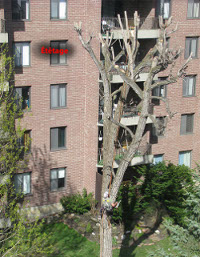
Tree topping is one of the practices with the most devastating effects on the health of our trees. Topping occurs when the head or crown of the tree is cut off. Such practices inevitably lead to the death of the tree, as it can no longer produce the energy it needs to live. In addition to being completely harmful to the tree, these practices darken our urban landscapes by exposing us to mutilated trees deprived of their majestic form.
Pruning with more than 20% of the living mass removed
To preserve the health of the tree, it is important to remove a maximum of only 20% of the tree's living mass. By pruning a larger percentage than suggested, your tree's health is threatened because the tree needs its leaves to perform photosynthesis. By removing too much of its foliage, a major drop occurs in the production of glucose necessary for its maintenance and growth. Since the tree experience an energy drop, it will fight back by stimulating the growth of a significant amount of suckers and sprouts that will require more frequent pruning. As reserves are exhausted, the tree's roots regress, which can affect its anchoring stability in the ground.
Trees cut into "balls"
This type of pruning is often requested for its aesthetic and visual appearance. The result can be quite impressive in the short term, but when we look at the long-term consequences, this cut is certainly not a good pruning practice to perform. In the years following this hack job, the tree will encounter serious problems. The structure will be compromised, weakening the tree. It is highly likely that you are depriving your tree of a very large percentage of the biomass it needs to survive.
Excessive Woundwood
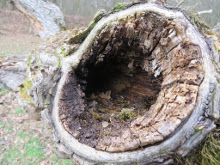
Large pruning wounds will never heal. They provide an open door for wound parasites such as microscopic fungi. They take hold as soon as the wound is created or within the few days following the cut. These are fungi that attack the tree's living tissue. Since the sap-conducting vessels become obstructed, diseases develop. As for wood-decay fungi, they feed on the tree's dead tissue by decomposing it from the inside. Large cavities form in the heart of the tree, weakening its stability and mechanical resistance. It is very difficult to treat this type of fungus. Decay will set in and gradually move down the trunk toward the roots: the tree's lifespan will be cut in half. Trees with large scarred wounds are also at higher risk of harboring insect pests. Pruning therefore represents a risk to your tree's health. It is thus vital that the cut be performed correctly by professionals.
And where does Arboquébec stand in all this?
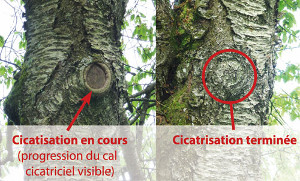
Our employees share our arboricultural values, which allows us to offer quality professional pruning services. Everyone has been trained and possesses the necessary skills to properly maintain your trees. We do not offer topping, "ball" cutting, or pruning of more than 20% of the tree's living mass, as these practices jeopardize your tree's life expectancy. These practices go against our values and our desire to protect this plant heritage that is dear to us. We also perform cuts that promote optimal healing.
By calling upon professionals in the arboricultural field, you are choosing quality work aimed at preserving the health of your trees and maintaining their majestic form.