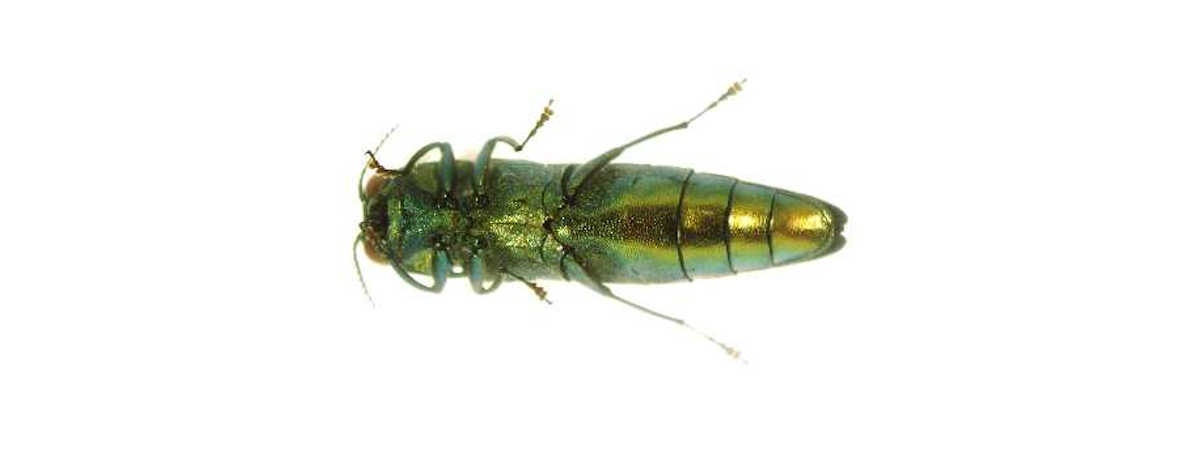
The emerald ash borer (Agrilus planipennis) belongs to the order Coleoptera, specifically the Buprestidae family. This shiny emerald-green insect originates from southern Asia and is believed to have arrived in North America through wood packaging and pallets used in imported goods from Asia in the early 1990s.
Once well established in an area, these insects can destroy up to 99% of ash trees within 8 to 10 years. Male borers spread the species by flying from one location to another, while infested wood products transported across regions further accelerate their spread into new territories. In Ontario and several U.S. states, the emerald ash borer has caused the death of tens of millions of trees.
Signs and Symptoms of Emerald Ash Borer Infestation
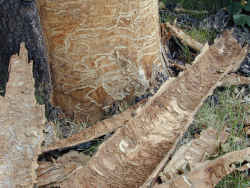
For the first 2 to 3 years, detecting an emerald ash borer infestation can be challenging because these insects primarily target the upper canopy of the tree. An infestation is identified when an ash tree shows physical damage caused by insects.
Key signs of emerald ash borer infestations include:
- Female borers lay eggs under the tree’s bark, producing larvae that cause irreversible damage to the ash tree over time.
- As larvae feed, they carve distinctive S-shaped tunnels, disrupting sap and water flow, ultimately killing the tree.
- Small D-shaped exit holes appear on the bark or trunk—these are where adult borers emerge.
- Other potential symptoms include:
- Declining canopy health and wilting branches
- Excessive seed production in ash trees (abnormally high samaras)
- Unusual growth of adventitious shoots on the trunk or branches
- Vertical bark splitting, exposing galleries created by larvae
- Leaves with notches, caused by adult borers feeding
- Dead ash trees within a forest, which may indicate nearby infestations
- Frequent sightings of woodpeckers and squirrels, as they target infested trees for food
Given the complexity of identifying infestations, consulting an arborist is highly recommended.
Impact on Forests and Wildlife
In Canada, hundreds of thousands of ash trees have died, significantly altering forest landscapes. As ash tree populations decline, forests become more exposed, increasing soil erosion into waterways due to weakened root systems. In areas with substantial ash tree loss, water temperatures in rivers rise due to greater sun exposure, negatively affecting aquatic ecosystems. The loss of ash trees also threatens herbivores that rely on them for food, while invasive species take advantage of the disrupted ecosystem to spread further.
How Can We Save Infested Ash Trees?
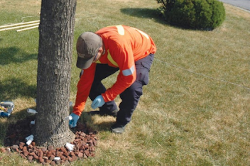
In Canada, no natural predators exist to control emerald ash borer populations. Infested trees cannot survive unless treated in time. If an ash tree is less than 30% infested, a bioinsecticide treatment can effectively stop the infestation.
The primary treatment used is TreeAzin MD, a certified biopesticide that serves as an eco-friendly alternative to chemical pesticides. This natural treatment is safe for humans and animals and has been recognized as environmentally low-risk. TreeAzin MD is injected at the tree’s base, functioning like a vaccine. Once treated, the tree is protected for up to two years. Treatment costs vary based on tree size and must be performed between June and August.
Economic Consequences
Ash wood is highly valued for its durability and resilience, making it an important material for manufacturing furniture, hardwood flooring, tool handles, sports equipment (such as hockey sticks), and electric guitars. The widespread death of millions of ash trees in North America has impacted industries that rely on ash wood, while billions more ash trees remain vulnerable. Municipalities also face significant costs managing the crisis.
Research Efforts to Combat This Threat
Extensive research has been conducted to find ways to combat the emerald ash borer infestation. Canadian scientists have identified a natural predator, the Asian wasp (Tetrastichus planipennisi), which may help reduce borer populations.
Scientists place small logs containing female wasps on infested ash trees. The wasps lay their eggs inside the tree’s bark, directly inside emerald ash borer larvae, which the wasp offspring then consume from within. These parasitic wasps help naturally control the emerald ash borer population, similar to their role in Asia, where emerald ash borers are not a major threat. Importantly, these wasps do not sting humans or animals and die off naturally once emerald ash borers are eradicated. Although this method was introduced in 2013, its long-term impact is still being studied.
Another experimental approach involves fungal-based control methods. Scientists are testing green-colored tubes, which attract emerald ash borers and contaminate them with the fungus Beauveria bassiana. This fungus contains deadly toxins for emerald ash borers. The insects die within five days after exposure.
These fungus-infused tubes will be installed in early June, during the borers’ mating season, ensuring that infected males spread the fungus to females, thereby contaminating eggs and slowing down infestation rates.
With continued research and the application of biological control methods, scientists hope to significantly reduce the spread of the emerald ash borer in the coming years.
Sources
https://www.rncan.gc.ca/nos-ressources-naturelles/forets-foresterie/feux-de-vegetation-insectes-pert/principaux-insectes-maladies-des/agrile-du-frene/13378
https://www.longueuil.quebec/fr/frene
https://arbrescanada.ca/blogue/lagrile-du-frene-un-insecte-a-limpact-devastateur/
https://traitementagriledufrene.ca/agrile-du-frene/
https://ici.radio-canada.ca/nouvelle/1097074/agrile-frene-gdg-environnement-trois-rivieres-projet-pilote-agent-biologique