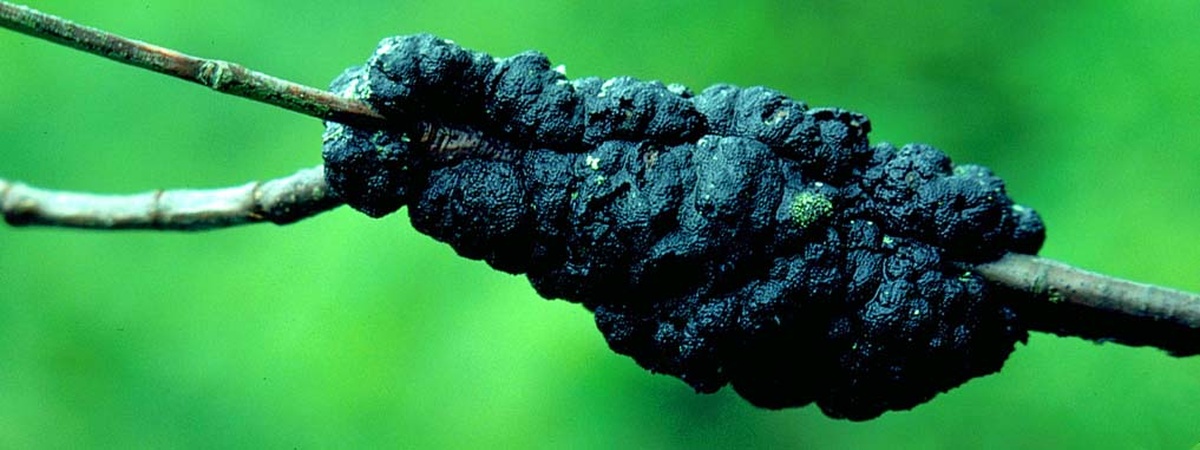
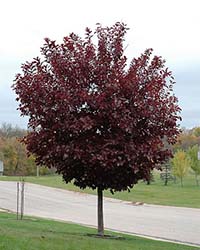
People often ask about strange black lumps or growths on a tree. The first question to ask is whether the leaves turn red in season, as this issue frequently appears on the Schubert chokecherry (Prunus virginiana 'Schubert'), which is commonly planted in rural areas (for reasons unknown). If the answer is yes, which is the case most of the time, the diagnosis is fairly straightforward.
This condition is black knot, a fungal disease caused by Apiosporina morbosa (syn. Dibotryon morbosum), which affects some fruit and ornamental trees—primarily cherries and plums, and occasionally apricots and peaches.
The knots can grow up to 20 cm in length and 4 cm in diameter. They gradually encircle branches and twigs of all sizes. Once entirely surrounded, the sections beyond the knots die. The spores are usually carried by the wind but can also spread through improper tool hygiene when someone attempts tree maintenance without disinfecting their tools. Once black knot infects a tree, it spreads, and new knots appear throughout. Their numbers increase year after year.
The disease reduces tree productivity because severely infected trees lose vigor, and managing the disease requires pruning infected branches. If you plan to do this yourself, it is essential to disinfect your tools between each cut. Do not keep infected plant material in your yard or compost. If burning is not an option, discard the infected parts in the trash.
Black knot is very difficult to control and will ultimately kill the tree if left untreated. Consider consulting an arborist to assess the severity of the issue and determine the best course of action. If necessary, tree removal may be recommended immediately to prevent further spread of the disease.